

You Tube and social media are recognized disrupters of almost everything. Now you can add surgery to the list.
Hernia is the general name given to the protrusion of something through a retaining structure into an area where it does not belong. There are all kinds of hernias: brainstem, inguinal, stomach, diaphragmatic and so on. Today, I want to discuss stomach hernias.
A stomach hernia occurs when there is a tear in the muscles of the abdominal wall and organs push through. They can be small or large. Small hernias may not need to be repaired and, if they are, it is usually a minor procedure in which the organs are put back where they belong and the edges of the abdominal muscles are pulled together and sewn. Sometimes mesh is used to reinforce the area where the tear has been. Being a minor procedure, there is not a lot of money to be made doing the surgery. Things changed in 2006 when some surgeons began using the robotic surgery device pictured below to do routine hernia repairs.
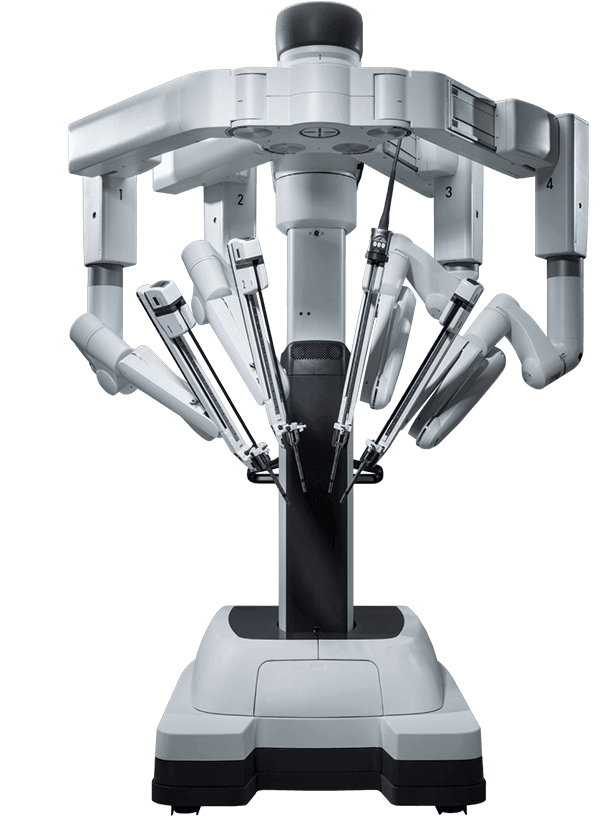
This is an image of a da Vinci robotic surgical system device. The system is manufactured by Intuitive and is intended for the minimally invasive surgery market. Before 2006, there was no role for it in minor abdominal hernia repairs. Beginning in 2006, in addition to starting to use it for routine repairs, some surgeons advocated its use in what is called component separation surgery to repair large abdominal hernias. In large abdominal hernias, there has been so much extrusion of abdominal organs and the opening is so large that the edges of the hernia cannot be brought back together to be sewn. Something else needs to be done to enable surgeons to close the opening. Component separation surgery provides a solution.
In component separation surgery, the surgeon uses the robotic arms to make vertical cuts to the abdominal muscles on either side of the hernia. These cuts allow the surgeon to pull the edges of the hernia together and sew them. The surgeon then returns to the incisions and sews them back up.
Surgeons doing the new robotic component separation procedure posted videos of their surgeries on You Tube and Facebook. Other surgeons watched those videos and began to do the procedure themselves. They were no doubt encouraged by the fact that they were able to bill many times more dollars for robotic-assisted hernia repair than for routine abdominal hernia repair surgery done without the robot. They could make even more money doing robotic-assisted component separation repairs. Problems soon developed.
One of the problems involved our old friend greed. Given an opportunity to make more money, some surgeons leapt at the chance, even when there was no advantage to using the robot and even when component separation surgery was not the best choice for the patient. A study of the subject performed at the University of Michigan found that one-third of the patients undergoing component separation surgeries were candidates for the simpler, less expensive, less dangerous, routine hernia repair surgery. They did not need robot-assisted surgery and they certainly did not need component separation surgery. In addition to performing component separation surgery on many patients who didn’t need it, some surgeons billed separately for each incision they made during the procedure, effectively turning one surgery into three or four. Lots more money that way.
A second problem, and perhaps the most significant, is that the component separation surgery is complicated, easy to screw up, has substantial risks associated with it and has a steep learning curve. To make matters worse, many of the videos posted on social media, supposedly showing how to do the surgery, were full of mistakes. Surgeons who taught themselves to do the procedure by watching videos, copied the mistakes of the surgeons who posted the videos. Patients were injured as a result, some permanently and badly. Because the operation is so complex with such small tolerances, even surgeons who were trying to do the procedure correctly, injured patients while learning how to do it.
There are, of course, some lessons to be learned. The first is that doctors are always on the lookout for ways to bill more for what they do. There is an unholy alliance between doctors, hospitals and device manufacturers to squeeze as much money out of the system as possible. We end up footing the bill. The second is that You Tube is a very poor way to learn a new surgical procedure, especially if it is complex and carries a high risk. Surgeons know that but the desire for more income is strong and their belief in their skills is unreasonably high. The final lesson is that patients almost always end up with the short end of the stick. If someone has to suffer for the greed of those in the health care system, the big players will always make sure that it is not one of them. That leaves only the patient and the general public to bear the burden.



